

Where Should Your Ducted Air Conditioning Controller Go? A Sydney Installer’s Guide


Published on 20 Oct 2026
Your ducted air conditioning controller should go on an internal wall in the room your household uses most, usually the main living area, about 1.5 metres off the floor and away from sunlight, windows, external walls, kitchens and air vents. In most Sydney ducted air conditioning installations, the controller houses the temperature sensor that runs the whole system, so it has to read the room’s true temperature. Put it in the wrong spot, and the system heats or cools to a false reading, leaving the rooms you actually live in too warm, too cold, or more expensive to run.
It is a warm January afternoon. The system has run since lunch, the controller says 24 degrees, and the lounge room still feels sticky. You drop the set point to 22, then 21. The air coming out of the vents feels cold enough, but the room never quite gets there, and by evening the bedrooms at the back of the house are freezing.
Most homeowners assume something has broken. Sometimes it has, and there are clear signs your ducted system needs repairs worth ruling out. But on many Sydney callouts, the system is doing exactly what it was designed to do. It is responding to a temperature reading taken from the wrong place.
That reading comes from the wall controller. Knowing where to put your ducted air conditioning controller is one of the few installation decisions that is easy to get right on paper and frustrating to fix later.
Why Does Controller Placement Matter?
Placement matters because the wall controller holds the temperature sensor that tells your ducted system when to work harder and when to ease off. If that sensor reads the wrong temperature, every decision the system makes is based on bad information.
The controller is more than a remote fixed to the wall. In most standard ducted setups, it is also the system’s thermometer. The indoor unit up in the roof has no idea how warm your living room is, so it relies on the controller’s sensor and adjusts its output to close the gap between that reading and your set temperature.
The system cannot tell the difference between a genuinely warm room and a sensor sitting in a patch of afternoon sun. It responds to the reading, not to how the house feels. A badly placed controller usually causes one of three problems:
- Over-cooling or over-heating: the sensor reads warmer or cooler than the room, so the system keeps running long after the living areas are comfortable.
- Under-cooling or under-heating: the sensor is satisfied too early, so the system backs off while the rest of the house is still uncomfortable.
- Short-cycling: the reading swings up and down quickly, so the system switches on and off in short bursts, which wears parts faster and wastes power.
All three affect comfort, and all three show up on your power bill. If you have looked into how much a ducted system costs to run in Sydney, a system chasing a false reading will always sit at the expensive end of the range.
What Room Should the Controller Go In?
For most Sydney homes, the controller belongs in the living room or main family area, mounted on an internal wall. This is the space the household occupies most, so its temperature is the best guide to how comfortable the home actually is.
The best room for a ducted air conditioning controller is simply the one where your family spends most of the day. If that is an open-plan kitchen, dining and living space, it should be the reference point. When the controller reads that room accurately, the system holds the temperature where it matters most.
The exact spot matters too. When we work out where to install a ducted air conditioner wall controller, we look for an internal wall roughly 1.5 metres off the floor, with nothing blocking it. Behind a bookshelf, next to a curtain or beside a draughty doorway are poor choices, because the sensor needs to read the open room.
Smart zoning systems, such as those using Advantage Air, Airtouch or Daikin zone controllers, can place a separate sensor in each zone, which eases the pressure on a single controller location. More on that below.
Where Should You NOT Put the Ducted AC Controller?
Good ducted air conditioning controller placement means avoiding any spot where something other than the room’s air can heat or cool the sensor. Sunlight, external walls, cooking heat, air vents and rarely used rooms are the most common problems we find on Sydney callouts.
- In direct sunlight or near a window. Sun falling on the controller heats the sensor directly, so it reads well above the actual temperature of the room. The system keeps cooling to fix heat that is not really there, and the living area ends up over-cooled. West-facing walls in Sydney’s late-afternoon sun are the worst.
- On or near an external wall. External walls soak up outdoor heat during the day and pass it through to the inside surface. A controller mounted there reads the wall as much as the room, which skews the reading on hot summer afternoons and cold winter mornings. It is a common ducted AC thermostat location mistake in older Sydney double-brick homes, where stored heat lingers for hours after sunset.
- Near the kitchen or laundry. Ovens, cooktops, dishwashers and dryers all give off heat. A controller beside them registers a spike every time someone cooks dinner or runs a load, and the system responds as though the whole house has warmed up.
- Near a ceiling vent or return air grille. If conditioned air blows across the controller, the sensor reads the air coming out of the system instead of the room. It hits the set temperature almost straight away and backs off, leaving the rest of the space warm in summer and cool in winter. A return air grille right beside it causes a similar draught problem.
- In a room that is rarely occupied. A spare bedroom, formal lounge or home office used twice a week tells the system nothing useful about where your family spends its time. The system ends up getting an empty room’s temperature just right while the main living areas stay uncomfortable.
- Inside a cupboard, alcove or behind a door. Enclosed spots trap still air that warms or cools at a different rate than the room. The sensor reacts late to changes everyone else in the room can feel.
Can You Move a Ducted AC Controller After Installation?
Yes, a ducted AC controller can be moved after installation. It is a straightforward job for a professional, but it adds cost and disruption that are easy to avoid by getting the location right the first time.
The controller’s wiring runs up through the wall and back to the indoor unit in the roof cavity, so relocating it needs a licensed electrician. The job involves running new cable, patching the old mounting point and checking the system reads correctly afterwards. It is not a DIY job.
The better option is to settle the controller location at the quoting and system design stage, when the installer is already looking at your layout, which rooms face north or west, and where the family spends its time. If you are still comparing quotes, it helps to know what happens during a ducted AC installation, so you can ask where the controller will go before any work starts.
At Gemin3, controller placement is part of our pre-installation consultation. Our installers walk through the home, ask how each room is used, and recommend a location before a single cable is run.
What About Smart Zone Controllers?
Smart zoning makes ducted AC zone controller placement far less critical, because it measures the temperature in each zone separately rather than relying on one sensor on one wall.
Systems such as Airtouch and Advantage Air use small wired or wireless sensors in individual rooms or zones. Each zone is managed against its own reading, so a sun-filled living room and a shaded back bedroom can both sit at the right temperature. For larger Sydney homes, double-storey layouts, north-facing living areas or rooms with big windows that take on a lot of heat from the sun, this can make a real difference to comfort. Smart zoning works best when the zones themselves are planned well, so it pairs naturally with working out how many zones you actually need at the design stage.
Frequently Asked Questions
Does it matter which wall the ducted AC controller goes on?
Yes. The controller should go on an internal wall, because external walls absorb outdoor heat and cold and pass it straight to the sensor. Choose a wall out of direct sunlight and away from windows, doorways and air vents, at around 1.5 metres off the floor. That gives the sensor the best chance of reading the room’s true temperature.
Can my ducted AC controller go in the hallway?
It can, but a hallway is usually a compromise. Hallways often run warmer or cooler than the living areas, catch draughts from doors, and are spaces people pass through rather than spend time in. If a hallway is the only practical option, choose a central spot well away from external doors, or ask about a system that can use a separate sensor in the main living area.
What happens if the controller is placed in the wrong room?
The system will heat or cool to suit the room the controller is in, not the rooms you actually use. That usually means uneven comfort, living areas that never quite reach the set temperature, and a system that runs longer than it needs to. Depending on the model, the system may be able to use a separate sensor instead, or the controller can be relocated by a licensed electrician.
Can I install a second controller in another room?
Many ducted systems support a second wall controller, which is handy in a double-storey or larger home where walking to the main controller is inconvenient. A second controller adds convenience, but it does not always add a second temperature reading, as many systems still rely on one designated sensor. Ask your installer how your specific model handles it before adding one.
Does controller placement affect my energy bills?
Yes. A controller reading a false temperature makes the system run longer, switch on and off more often, or cool and heat the house further than it needs to. All of that uses extra electricity. Correct placement is one of the simplest ways to keep running costs where they should be.
How far can the controller be from the indoor unit?
In a typical home, distance is rarely the deciding factor. The controller connects to the indoor unit by a cable run through the roof and wall cavities, and manufacturers allow cable lengths that comfortably cover a standard Sydney house. The practical limits are usually access, such as solid double-brick walls or tight roof spaces, which your installer will check during the site inspection.
If you are planning a ducted air conditioning installation in Sydney, or your current system never feels quite right, book a free quote with Gemin3. Our licensed installers advise on controller placement and system design before any work begins, so your system is set up correctly from day one. Explore our ducted air conditioning services or call 02 4089 4647 to arrange a consultation.
More articles you’ll like
View All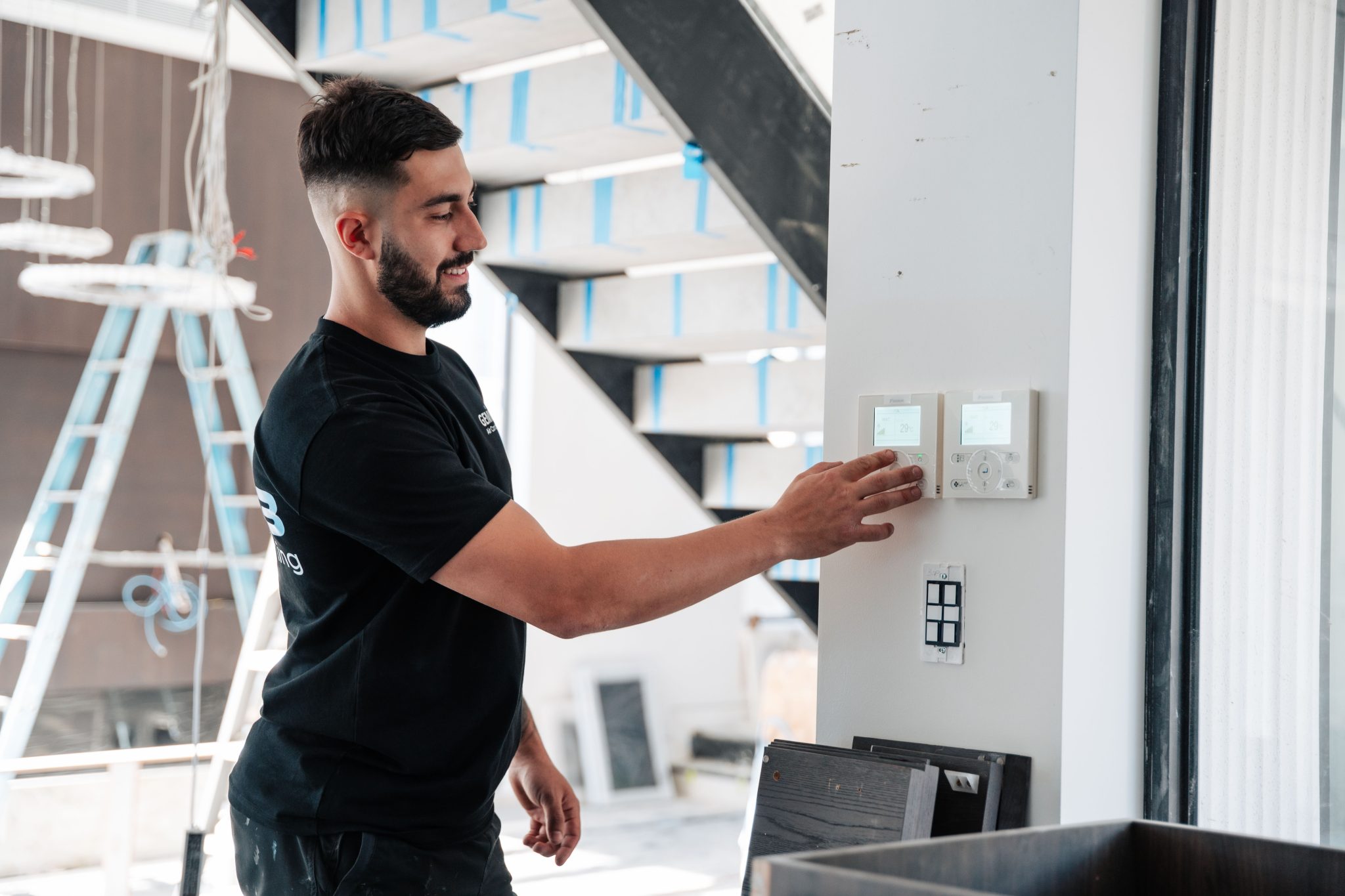
Can You Install Ducted Air Conditioning in an Existing Sydney Home?
One of the most persistent myths in the air conditioning industry is that ducted systems only work in new builds, planned in from the architectural drawings stage. It is simply not true. Ducted Air Co...
Read More...
How to Choose the Right Air Conditioning System for Your Residence
Choosing the right air conditioning system for your home is more than just a matter of comfort—it’s an investment in your quality of life. Our team at Gemin3 Air Conditioning understands that th...
Read More...
Choosing the Right Air Conditioning System for Modern Builds
Choosing the Right Air Conditioning System for Modern Builds Choosing the right air conditioning system for modern builds is a critical decision that can significantly impact both the comfort and ener...
Read More...Supplied. Delivered. Installed!
Air Conditioning Sydney Residents Trust - We’ve Helped Thousands Of Customers City Wide!